
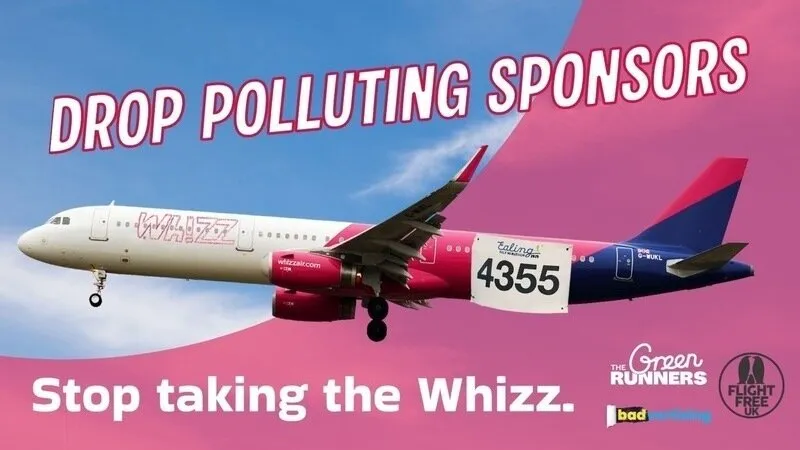

TGR member Katy Tallon says running shouldn’t sell flights. Here she shares her personal views on sportswashing.
There’s a word to describe when a polluting business dons a pair of trainers and hopes nobody notices the harm they cause: sportswashing. The Green Runners have written more about it here.
High carbon sponsorship of sport has been outraging me for years but this time it is personal.
Earlier this year I had the chance to run (in place of a friend) the Milan Marathon. I said no. The reason? Wizz Air was plastered all over it. What should have been a celebration of running looked like a glossy pink advertising campaign for flying. That might sound trivial. It isn’t.

This isn’t just sponsorship
Wizz Air is a low-cost airline that currently operates more than 1,000 routes with hundreds of aircraft and has ambitions to rapidly expand its fleet and destinations over the next five years – which could mean more than 100 million passenger trips a year.
At the same time, it is embedding itself deep into European running. Nearly 140,000 runners took part in their sponsored races in 2025. In 2026, Wizz Air became a partner of the World Athletics Ultimate Championship and continues to sponsor a series of major running events across Europe, including races in Milan, Budapest, Rome and Venice.
Hold up… Venice? A city already battling rising sea levels due to climate change! The irony is painful.
To add to the insult, the WIZZ Run Series has a competition offering runners the chance to win a range of prizes depending on the number of kilometres they run throughout Wizz Air-sponsored events. Prizes include the airline’s ‘All You Can Fly’ subscription! This isn’t an airline just putting its logo on races; this is an airline using running to sell flying.
Flying to run is not sustainable
We run in places and we run to explore and experience. places. This is why there’s no place for airline sponsorship with running. Airlines are fossil-fuel businesses. Their core product requires burning fossil carbon — the same process driving flooding, droughts, wildfires and extreme weather. So directly promoting one of the fastest-growing sources of climate pollution through a sport built around health, nature and place…that’s a huge conflict of interest!
In actively encouraging runners to jump on their flights to get to races, the environmental cost can be enormous. Many races have majority local participants but this changes for big city marathons like Milan. Participant travel can dominate the carbon footprint of mass-participation races. Run 4 Wales has reported that participant travel accounted for 98% of its total emissions across its events So how runners get to a race matters enormously.
Wizz Air’s clever accounting tricks
Wizz Air likes to highlight its green cred saying it has the ‘lowest carbon per passenger kilometre’ of any airline. But efficiency isn’t the same as emissions reduction. An airline can emit less per passenger while emitting more overall if it carries more passengers and operates more flights. And Wizz Air’s own figures show exactly that tension. Its carbon footprint increased by 4.6% in 2025 compared to the previous year, even as its emissions per passenger kilometre fell.
So yes, Wizz Air can become more efficient (largely by squeezing more people on the same flight to increase profit) and still emit more carbon. That isn’t a contradiction. It’s what happens when efficiency improvements are overwhelmed by growth. Wizz’s business model encourages more flying by making flights extremely cheap.
Being the ‘best’ airline is a bit like being the healthiest cigarette.
Katy Tallon
The UK advertising regulator has already challenged some of Wizz Air’s environmental marketing. In 2024, the Advertising Standards Authority banned a Wizz Air advert claiming it was “one of the greenest choices in air travel”, finding that the ad had missing comparison data. Wizz says the missing data the efficiency metric (per passenger) they seem so proud of –it’s a huge misleading impression of flying’s real environmental impact.
A better comparison would be train versus plane – not comparing one airline’s green creds against another or one high carbon journey against another. Flying is NOT low-carbon.
Wizz Air has a roadmap for net zero by 2050 but even they describe it as ‘aspirational’ not a formal commitment. There’s an aviation trick I’ve seen repeatedly in sustainability communications: talk about newer aircraft, efficiency, airport operations while quietly avoiding the main issue….fuel!
More than half of Wizz’s projected Scope 1 emissions reductions depend on sustainable aviation fuel (SAF). SAF may have an important role to play but in 2024, IATA calculated that SAF represented just 0.3% of global jet-fuel use. It’s high cost, comes with a land use issue at scale and importantly, SAF currently cannot simply replace the enormous quantity of kerosene used by global aviation. So, let’s not confuse a future pathway with a solution that exists at the necessary scale today.
Aviation isn’t just CO₂
Airlines love talking about fuel efficiency because it keeps the conversation focused on carbon. But carbon isn’t the whole story. Every flight also creates contrails and other high-altitude pollution that can contribute to warming. Once these effects are included, aviation’s climate impact is significantly higher than its CO₂ emissions alone suggest. Yet when airlines talk about “sustainable growth”, these impacts are often treated as a footnote rather than the elephant in the departure lounge.
And the impact of flying can be very local too. Wizz Air operates flight paths above the very races it sponsors – polluting the communities that races hope to support, not to mention polluting the air we rely on to run.
We don’t need perfect runners…we need better sponsors
I’m not pretending everyone can, or should, never fly. I’m saying that flying across Europe for races shouldn’t be the default aspiration of running culture — especially when the company selling you the flight is simultaneously using running to market more flying.
Dan Tipney is a former Airline Pilot and co-founder of Safe Landing: a global community of aviation workers and enthusiasts. They are clear that, ‘everyone in our Safe Landing community loves aviation and wants a positive future that lets people keep enjoying flying for generations. However, the WIZZ Run Series is unhelpful: it rewards excessive flying without a real solution to its environmental impact — a risk to both the planet and aviation’s future… many pilots I’ve worked with agree the industry is off-track, too focused on lobbying for meaningless tools like offsets rather than effective climate policies. In doing so, we’re not just misleading the public with greenwash, we’re misleading ourselves, risking our own industry’s future.’
This isn’t anti-flying (well, not if we’re being selective of the flights we do choose to take). It’s about what we want running to stand for: health, community and nature — not selling more flights.
So many running event organisers do great work in reducing waste, eliminating single-use plastics, protecting trails and encouraging sustainable transport. Fantastic. But by putting an airline at the centre of its marketing, it’s (I’m afraid) all undone.
But we can run in Milan without making flying the hero. We can race in Rome without turning the journey into an airline advert. We can visit Venice without pretending that more aviation is compatible with protecting vulnerable places.
There is good news. Courts and regulators are starting to catch up. A Dutch court found 15 of 19 KLM environmental claims misleading, including claims relating to SAF and offsetting. Many cities, whilst not reducing flying are banning advertising by airlines. The Hague has prohibited public-space advertising for fossil-fuel products and high-carbon services including air travel and cruises. …no Wizz air Run Series in the political capital of the Netherlands then!
What can we do?
Runners: ask why an airline is so keen to put its name on our sport in the first place. Boycott races with high-carbon sponsors where you can
Race organisers: stop taking sponsorship from airlines or other high carbon sposnors asap.
Everyone: support sponsorship that aligns with health, community and a liveable planet — not increased fossil-fuel consumption.
Join the campaign
The Green Runners and friends Badvertising and Flight Free UK are calling on races to rethink high-carbon sponsorship and are campaigning specifically against Wizz Air’s growing presence in running. Sign the petition here.
Don’t give Wizz Air a lap of honour.